
Your claims sell the product before the formula ever gets a chance. "Brightening." "72-hour hydration." "Dermatologist tested." "Suitable for sensitive skin." These phrases do most of the work at the shelf and on the product page, and they are also where most of your regulatory exposure sits. A product with a clean ingredient list and a solid safety dossier can still get a warning letter, a competitor challenge, or a class action because of a few words on the front of the box.
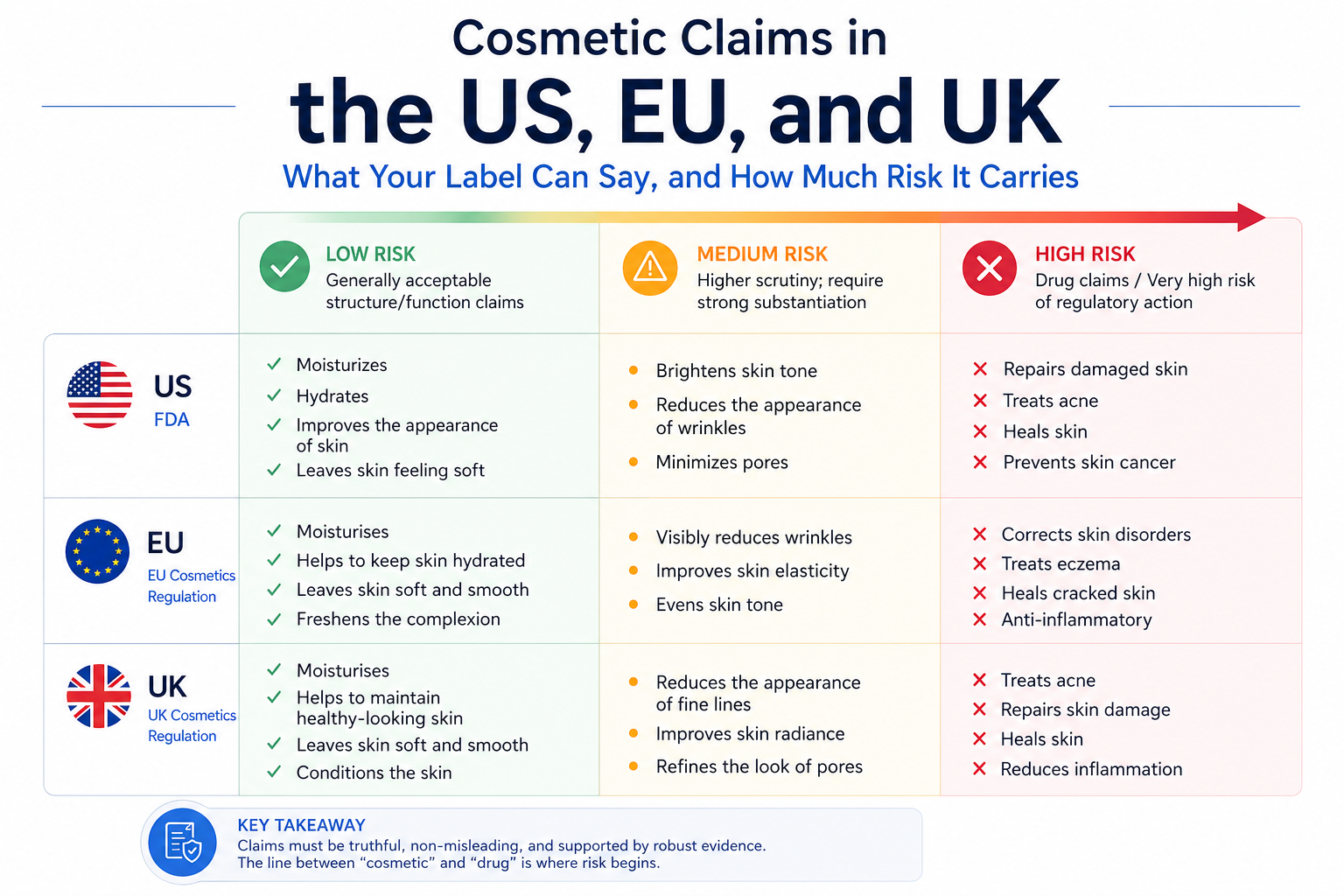
If you're entering the US, EU, or UK, the first thing to know is that these markets regulate claims through very different mechanisms. The second thing matters more in practice: none of them treat a claim as simply "legal" or "illegal" the way an ingredient is either permitted or banned. Claims sit on a spectrum of defensibility. Reviewing them well means measuring risk, not checking boxes. For Korean brands in particular, whose home market rewards a very different style of claim, this shift in mindset is usually the hardest part of the adaptation.
The United States: The Cosmetic-Drug Line and the FTC
The US has no dedicated cosmetic claims regulation. Risk comes at you from two directions instead.
The first is the Federal Food, Drug, and Cosmetic Act (FD&C Act). Sections 201(g) and 201(i) define drugs and cosmetics by intended use, and intended use is established largely through what you claim. A cosmetic cleanses, beautifies, or alters appearance. A drug treats, prevents, or affects the structure or function of the body. So when your moisturizer claims to "stimulate collagen production," "repair the skin barrier," or "treat acne," the FDA can treat it as an unapproved new drug no matter what's actually in the bottle. This line gets drawn by your copywriter, not your chemist, and it's the most consequential one in US cosmetic marketing. If you read through FDA warning letters to cosmetics companies, the overwhelming majority cite drug-type claims rather than ingredient problems.
The second direction is the Federal Trade Commission. Under Section 5 of the FTC Act, advertising claims (express and implied) must be truthful, non-misleading, and substantiated before you make them. The FTC standard is "competent and reliable scientific evidence," and for anything health-adjacent it increasingly expects human testing on the finished product or a closely matched formulation. On top of the FTC itself, the US has two enforcement layers with no real European equivalent: the National Advertising Division (NAD), an industry self-regulatory forum where competitors routinely challenge each other's claims, and the plaintiff's bar. Consumer class actions over "clean," "natural," "non-toxic," and unsupported performance claims have become a fixture of US beauty litigation, and settlements are not cheap.
The European Union: Six Common Criteria
The EU takes the opposite approach and regulates claims explicitly. Article 20 of Regulation (EC) No 1223/2009 prohibits attributing characteristics or functions to a product that it doesn't have. The working rules sit in Commission Regulation (EU) No 655/2013, which sets out six "common criteria" every claim must satisfy: legal compliance, truthfulness, evidential support, honesty, fairness, and enabling informed decision-making.
Evidential support is where most of the practical work happens. Claims need adequate and verifiable evidence, which can include experimental studies, consumer perception tests, or published data, and the strength of the evidence has to match the strength of the claim. "Feels hydrating" and "clinically proven to increase hydration by 40% over 72 hours" require very different dossiers. That evidence lives in the Product Information File held by your Responsible Person, and national competent authorities can ask for it at any time.
Keep the Technical Document on Cosmetic Claims (2017) close as well. Its annexes deal with "free from" claims and "hypoallergenic" specifically. Claims like "free from parabens" are now largely considered non-compliant when they denigrate legally permitted ingredients. This is a hard adjustment for K-beauty brands, since the Korean domestic market rewards exactly that kind of messaging.
The United Kingdom: Same DNA, Different Enforcers
After Brexit, the UK kept the substance of the EU regime as the UK Cosmetics Regulation (Regulation 1223/2009 as assimilated into UK law, amended by Schedule 34 of the Product Safety and Metrology etc. (Amendment etc.) (EU Exit) Regulations 2019). The six common criteria apply in materially the same form, so a claims dossier built for the EU travels well.
What differs is who enforces it and how. The Advertising Standards Authority (ASA), applying the CAP and BCAP Codes, is an unusually active regulator of beauty advertising. Its rulings, including on influencer content and social posts, are published weekly and are name-and-shame by design. The Competition and Markets Authority (CMA) has become a second force to take seriously. Its Green Claims Code governs environmental marketing, and under the Digital Markets, Competition and Consumers Act 2024 the CMA can now fine businesses up to 10% of global turnover for unfair commercial practices directly, without going through the courts. "Clean beauty," "eco," and "sustainable" claims in the UK now carry real financial consequences.
Claims Review Is Risk Measurement, Not a Verdict
This is the part that surprises a lot of brand teams. Outside a handful of bright lines (drug claims in the US, the prohibited claims in the EU technical document annexes), almost no claim can be certified as definitively compliant. No regulator in these three markets pre-approves cosmetic claims. What a good claims review actually produces is a risk profile: how defensible each claim is, against which enforcement mechanisms, with what likely consequences if challenged.
In practice, a useful review weighs at least four things. Claim strength versus evidence strength: a percentage figure, a timeframe, or the word "proven" raises the substantiation bar sharply, and the question is whether your dossier as it exists today can carry that weight. Classification risk: does the claim, read in context, push the product toward drug or medicinal status? Enforcement likelihood: who is actually policing this claim type right now (FDA warning letters, ASA rulings, NAD challenges, class action firms) and how visible is your product to them? And commercial blast radius: a challenged hero claim on your flagship SKU is a very different problem from a soft claim on a minor product.
Thinking this way changes the decisions you make. Sometimes the right call is to keep an aggressive claim and invest in the clinical study that makes it defensible. Sometimes a one-word rewrite does it: "repairs" becomes "supports," "anti-inflammatory" becomes "soothes," and the claim moves from the red zone to the green without losing marketing impact. And sometimes the analysis shows a claim your team assumed was risky is well within norms for the market, so you keep it. None of these outcomes come from a binary legal/illegal checklist. They come from measuring risk and deciding, deliberately, how much of it you're willing to hold.
What This Means for Brands Entering These Markets
If you're a Korean brand preparing US, EU, or UK launches, your claims were almost certainly written for a different regulatory culture, one where whitening claims, quasi-functional language, and free-from marketing are normal. Translating the words is easy. Translating the risk posture is the real work. Build your substantiation file before your launch copy, not after. Review every claim against the market's specific enforcement landscape rather than some generic global standard. And treat the output as what it is: a risk map that supports informed commercial decisions, not a stamp of absolute safety that no honest reviewer can give you.
Reviewing claims for a US or EU launch?
Noedal helps K-beauty brands assess claim-by-claim risk across US, EU, and UK requirements, with substantiation gap analysis and market-ready rewrites that keep your marketing voice intact.
Talk to Noedal