
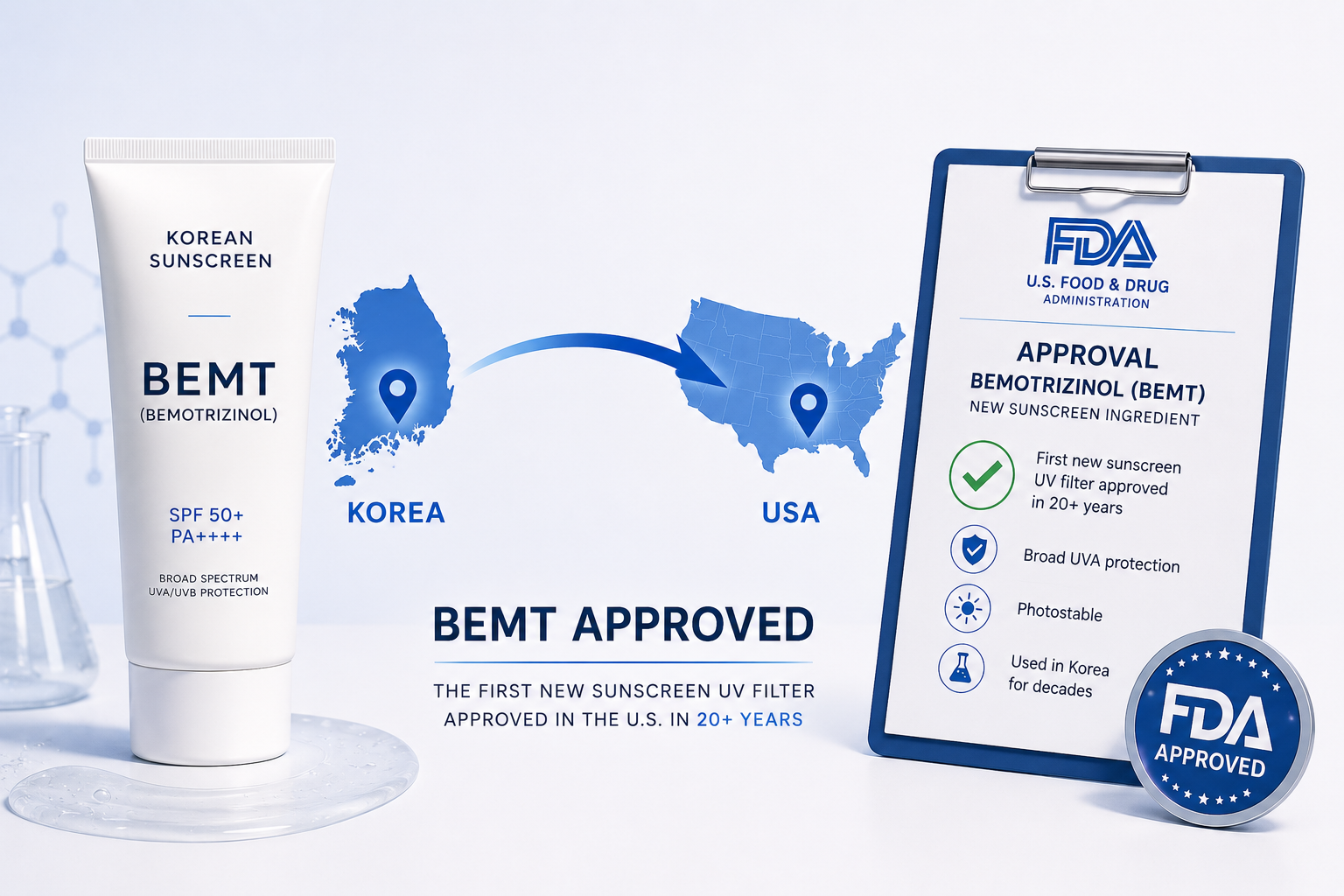
On June 9, 2026, the US Food and Drug Administration added bemotrizinol (BEMT) to the over-the-counter sunscreen monograph as a permitted active ingredient. It's the first new UV filter approved in the US since the late 1990s. The FDA concluded that bemotrizinol is generally recognized as safe and effective (GRASE) at concentrations up to 6%, for adults and children as young as 6 months, after a seven-month review under the streamlined process created by the CARES Act.
If you work in K-beauty, you already know why this matters. BEMT, sold globally as Tinosorb S by BASF and PARSOL Shield by dsm-firmenich, is one of the workhorse filters behind the light, photostable textures that built the global reputation of Korean sunscreen. It absorbs across UVA and UVB, holds up in sunlight where avobenzone breaks down, and barely penetrates the skin. It has been used in Europe and Asia since around 2000. American consumers have spent the past decade reading about why Korean sunscreens are better, and importing them through gray-market channels, precisely because filters like this were not allowed in US formulas.
Now it is allowed. That changes the math for every Korean sunscreen brand looking at the US.
The "No Reformulation" Opportunity
Until now, the standard playbook for Korean brands entering the US was painful. Strip out the modern filters, rebuild the formula around the old US-permitted actives, and accept that the American version of your sunscreen would not feel or perform like the original. Consumers noticed. "US version vs. Korean version" comparisons became their own genre of content, and the US version rarely came out ahead.
With BEMT approved, that compromise may no longer be necessary for many formulas. If your sunscreen's filter system is built on BEMT alongside other US-permitted actives, there is now a realistic path to entering the US market with your original Korean formula: the same texture, the same finish, the same efficacy that earned your reviews at home.
"Is the bemotrizinol (BEMT) in our formula supplied by dsm-firmenich (PARSOL Shield) or BASF (Tinosorb S)?"
The supplier matters because of exclusivity. Under the CARES Act framework, the company that carried BEMT through the FDA process, dsm-firmenich (through its subsidiary DSM Nutritional Products), holds an 18-month market exclusivity period for the ingredient in the US, covering the company and its licensees, assignees, and successors. During this window, US market access for BEMT products runs through appropriately sourced material. If your OEM/ODM sources its BEMT from dsm-firmenich's PARSOL Shield, or from BASF's Tinosorb S under a qualifying arrangement, you are likely in a position to enter the US with your existing formulation. If your manufacturer can't answer the sourcing question, that is the first thing to resolve.
Why Speed Matters
The "Korean sunscreens are better" narrative has been building in the US for a decade, mostly without Korean brands being able to capitalize on it at full strength. The BEMT approval turns that pent-up demand into an addressable market. The catch is that it does so for everyone at once. Kenvue has already confirmed plans to bring bemotrizinol into its US lines, and other major Western brands will not sit this out.
The brands that win this window will be the ones that show up first with the real thing. An original Korean formula isn't just an operational convenience here. It's the marketing claim itself. It lets American consumers verify in daily use everything they've read about Korean SPF: the finish, the wearability, how it sits under makeup. "The same formula sold in Seoul" is a story a reformulated competitor simply can't tell. But a first-mover advantage only exists for brands that actually move first. Once shelves fill up with BEMT products from global players, the differentiation shrinks and customer acquisition gets expensive.
Between now and the final order's effective date of August 9, 2026, there is a preparation window: confirming filter sourcing with your manufacturer, screening your formula against the monograph, and getting ready for the OTC drug requirements that US sunscreens carry. Sunscreens are regulated as OTC drugs in the US, which means Drug Facts labeling, SPF and broad-spectrum testing to FDA protocols, facility registration, and drug listing. It's a meaningfully different compliance stack from cosmetics. Brands that use this window well can be on US shelves while the story is still fresh.
The Path Forward
The sequence is straightforward. Verify your BEMT supply chain with your OEM/ODM. Screen your full filter system and formula against the US monograph. Map the OTC drug requirements for your specific product. Then build your launch timeline backward from the exclusivity window and the competitive landscape. None of these steps is exotic, but each one has failure modes that cost months, and months are the scarcest resource in this particular race.
Enter the US with your original formula.
Noedal helps Korean sunscreen brands assess US market entry without reformulation, from BEMT sourcing verification and monograph screening to full OTC compliance planning. Find out in one conversation whether your original formula can make the trip.
Book a free consultationNo commitment. We'll tell you honestly whether your formula qualifies, and what it takes if it doesn't.